Here’s something that’ll blow your mind: the way fintech companies decide whether to lend you money is getting a serious upgrade. And I’m not talking about minor tweaks to old formulas — I’m talking about reinforcement learning algorithms that literally learn from every lending decision they make.
How AI Image Compression Works: Neural Networks vs Traditional Algorithms
on
Get link
Facebook
X
Pinterest
Email
Other Apps
You know that moment when you’re trying to upload a photo and the site tells you the file’s too big? Yeah, we’ve all been there. You end up frantically Googling “compress image online” and hoping whatever tool you find doesn’t completely destroy your picture’s quality. But here’s the thing — image compression has gotten way smarter lately, and AI is kind of blowing the traditional methods out of the water.
Let me walk you through how this whole thing works, because honestly? It’s pretty fascinating once you get past the technical jargon.
How AI Image Compression Works
What Even Is Image Compression?
Before we get into the AI wizardry, let’s cover the basics. Image compression is basically the art of making your image files smaller without making them look like they’ve been through a blender.
Think of it this way: your phone’s camera captures images with insane amounts of detail — way more than you actually need for most purposes. Compression algorithms look at all that data and figure out what can be tossed or simplified without you noticing the difference.
Lossless compression — Keeps everything but packages it more efficiently (like PNG)
Most of the time, we’re dealing with lossy compression because, let’s be real, we need those file sizes down.
The Old Guard: Traditional Compression Algorithms
Traditional compression methods have been around forever — well, since the ’90s, which in tech terms might as well be the Stone Age. The most common one you’ve probably heard of is JPEG, and it uses something called the Discrete Cosine Transform (DCT).
How JPEG Actually Works
Here’s the breakdown without making your eyes glaze over:
Splits the image into 8x8 pixel blocks — Think of it like cutting a pizza into tiny squares
Converts spatial information to frequency information — This is where the DCT math happens
Throws away high-frequency details — Your eye doesn’t catch these anyway
Quantizes the remaining data — Basically rounds numbers to make them simpler
Packages everything up — Uses additional compression on the final result
It works, don’t get me wrong. JPEG has served us well for decades. But it has some pretty annoying limitations.
The Problem with Traditional Methods
Ever noticed how JPEG images get those blocky artifacts when you compress them too much? Or how they turn into a blurry mess around sharp edges? That’s because traditional algorithms follow rigid, predefined rules. They don’t actually “understand” what’s in your image — they just crunch numbers according to a formula.
JPEG doesn’t know whether it’s looking at your face, a landscape, or your cat. It treats everything the same way, which means it’s not exactly optimized for any specific type of content. Kind of like using the same seasoning on every dish regardless of what you’re cooking. :/
Now here’s where things get interesting. AI-powered image compression uses neural networks that have actually been trained on millions of images. These networks learn patterns, understand context, and can make intelligent decisions about what to keep and what to discard.
How Neural Networks Change the Game
Instead of following a fixed mathematical formula, neural networks approach compression more like how your brain processes visual information. They learn to recognize what’s important in an image and what’s just noise.
The basic process looks something like this:
Encoder network analyzes the image — Extracts the most important features
Bottleneck layer compresses the data — Forces the network to represent the image with fewer bits
Decoder network reconstructs the image — Uses the compressed data to rebuild the picture
Training refines the process — The network learns from millions of examples to get better
What’s wild is that these networks can be trained to prioritize different things. Want to preserve faces? Train it on portraits. Need sharp text? Focus the training on documents. The network adapts to what matters most.
Real-World AI Compression Examples
Companies are already rolling this stuff out. Google’s BPG (Better Portable Graphics) and their more recent work with learned image compression has shown some impressive results. Netflix uses neural networks to optimize video compression (which is basically image compression on steroids).
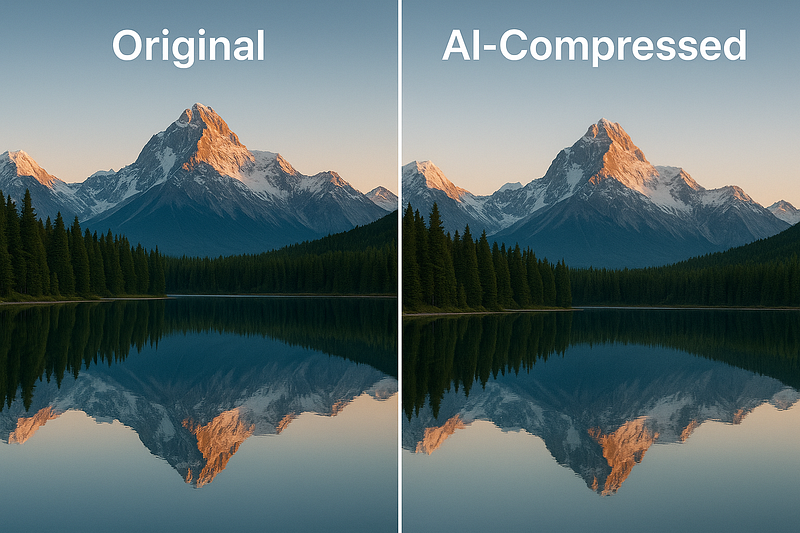
IMO, the most impressive part is that AI compression can actually beat JPEG at its own game, achieving the same visual quality with 30–50% smaller file sizes in many cases.
The Head-to-Head: Neural Networks vs Traditional Algorithms
Alright, let’s get into the nitty-gritty comparison. How do these approaches actually stack up against each other?
Speed and Efficiency
Traditional algorithms win on speed — at least for now. JPEG compression is lightning fast because it’s been optimized for decades and runs on simple mathematical operations. Your phone can compress a JPEG in milliseconds.
Neural network compression? It’s slower. Training these networks takes serious computing power (we’re talking GPUs running for days). Even the actual compression process takes longer because the network has to process the image through multiple layers.
But here’s the catch: hardware is getting better, and specialized AI chips are making neural network operations faster every year. The speed gap is closing.
Quality at High Compression Rates
This is where AI really shines. When you crank up the compression ratio — trying to squeeze files down to tiny sizes — traditional algorithms start falling apart. You get those ugly artifacts, blocking, and blurriness.
Neural networks handle extreme compression way more gracefully. They’ve learned which details humans actually care about and can preserve those while aggressively compressing everything else. The difference becomes especially noticeable at compression ratios above 20:1.
Handling Different Content Types
Remember how I said JPEG treats everything the same? Neural networks don’t have that problem.
Preserve fine details in faces while simplifying backgrounds
Keep text razor-sharp even at high compression
Maintain texture quality in important areas
Smooth out noise in low-light photos intelligently
Traditional algorithms apply the same compression strategy across the board, which is why JPEG struggles with things like computer-generated graphics or images with text.
Computational Requirements
Here’s the elephant in the room: neural network compression is computationally expensive. Training a good compression network requires massive datasets and powerful hardware. Even using a pre-trained network demands more processing power than traditional methods.
For individual users? This might not matter much — cloud services can handle the heavy lifting. But for applications that need to compress images on-device or in real-time? Traditional algorithms still have the advantage.
The Technical Deep Dive (For the Curious)
Want to understand what’s actually happening under the hood? Let’s get a bit more technical without going full computer science thesis on you.
Autoencoders and Variational Approaches
Most neural network compression uses something called an autoencoder. It’s basically a neural network sandwich:
Encoder — Compresses the image into a compact representation (the latent space)
Latent space — The compressed data, much smaller than the original
Decoder — Reconstructs the image from the compressed representation
The network learns by comparing its reconstructed images to the originals and adjusting its parameters to minimize the difference. Over millions of training iterations, it gets scary good at figuring out what information is essential.
Entropy Coding and Learned Quantization
Traditional compression uses fixed quantization tables — basically predetermined rules about which data to simplify. Neural networks can learn optimal quantization for different types of content.
They also incorporate sophisticated entropy coding that adapts based on the actual content being compressed, rather than using a one-size-fits-all approach. FYI, this is part of why AI compression can achieve better compression ratios — it’s making smarter decisions about every single piece of data.
Perceptual Loss Functions
Here’s something cool: neural networks can be trained using perceptual loss functions that actually measure how different an image looks to human eyes, not just how mathematically different it is.
Traditional algorithms minimize mathematical error (like mean squared error). But two images can have the same mathematical error while looking completely different to us humans. Neural networks trained with perceptual loss optimize for what we actually see, which leads to better visual quality.
The Practical Reality: Which Should You Use?
Ever wondered which compression method you should actually choose for real-world use? The answer is… it depends. (I know, I know, not super helpful, but hear me out.)
When Traditional Algorithms Still Make Sense
JPEG and other traditional methods aren’t going anywhere soon. They’re still your best bet when:
Speed is critical — Real-time applications, mobile photography
Compatibility matters — Every device and browser supports JPEG
You need “good enough” — Most casual use cases don’t require cutting-edge compression
Processing power is limited — Older devices, embedded systems
There’s a reason JPEG has survived this long. It works, it’s fast, and it’s universal.
When Neural Networks Are Worth It
AI compression really proves its value in specific scenarios:
Extreme compression requirements — When file size is absolutely critical
High-quality archives — Professional photography, medical imaging
Content delivery networks — Where small improvements translate to massive bandwidth savings
Specific content types — Faces, text, artistic images that benefit from content-aware compression
If you’re running a website with millions of images, shaving 40% off your file sizes with AI compression could save serious money on bandwidth and storage. That’s when the computational cost becomes worthwhile.
The Future: Hybrid Approaches and What’s Next
Here’s where things get really interesting: we’re starting to see hybrid approaches that combine the best of both worlds.
Some new compression standards are incorporating neural network components for specific tasks (like deblocking or super-resolution) while using traditional algorithms for the heavy lifting. This gives you better quality without the massive computational overhead of pure neural network compression.
WebP2 and AVIF (the newer image formats you might have heard about) incorporate machine learning techniques while maintaining reasonable encoding speeds. They’re not pure neural network approaches, but they’re learning from AI research.
And quantum computing? Yeah, that could change everything again in a decade or two. But let’s not get ahead of ourselves.
The Bottom Line
So here’s the deal: AI image compression using neural networks is genuinely better at the actual compression part. It produces higher quality images at smaller file sizes, especially when you need aggressive compression. The technology is impressive, and it’s only getting better.
But traditional algorithms still have their place. They’re faster, more widely supported, and perfectly adequate for most everyday use cases. You don’t need a Ferrari when a Honda will get you to work just fine.
The real future probably isn’t “AI vs traditional” — it’s figuring out how to blend these approaches intelligently. Use neural networks where they provide the most value, fall back to traditional methods where speed and compatibility matter more.
For now? I’d say keep using JPEG for your everyday needs, but keep an eye on those newer formats like AVIF that are starting to incorporate AI techniques. They’re the bridge between the old and new worlds of image compression.
And hey, at least now when someone asks you about AI image compression at a party (because that definitely happens, right?), you’ll actually know what you’re talking about. You’re welcome. 😊
Comments
Post a Comment